


When the House Goes Dark: A Story About Brotherhood, Accountability, and What We Built From the Ashes

Updated: Sep 21
There's a version of this story that starts with a Wednesday night in October 1997, in a modest motel room at the base of a hill below the Pullman campus. A handful of men, alumni, not active, sat around a table with heavy hearts and more difficult decisions in front of them.
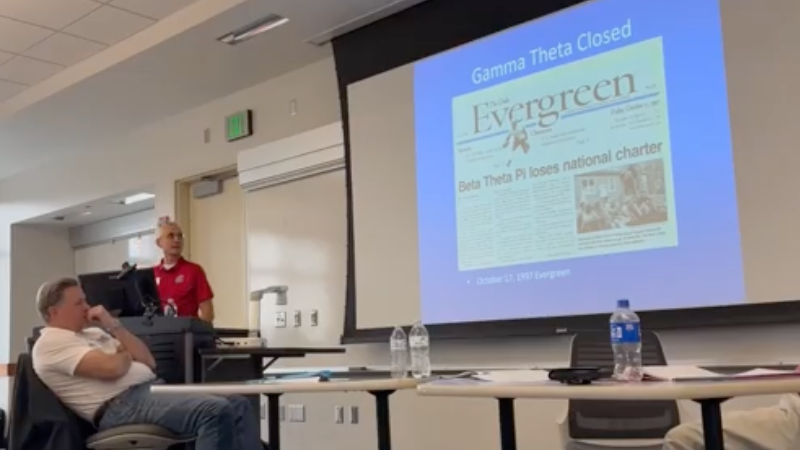
But the real story starts years earlier.
By the mid-1990s, the warning signs were already there. Alumni like Chris Marker, Mike Jones, and Pat Dix had been watching the Gamma Theta Chapter of Beta Theta Pi drift, slowly at first, then all at once. Alumni volunteers held meetings, made calls, and worked with the housing board to get the chapter back on track. Action plans were written. Commitments were made. Deadlines were set.
Then, quietly and systematically, they were ignored.
When alumni finally sat down with the Chapter President that fall week in 1997 and asked about progress on the agreed-upon plan, they got something worse than failure. They got lies.
The assembly didn't deliberate long. The vote was swift, the verdict unanimous: the house would close. What followed that Wednesday night is a chapter of history every active brother should understand not as a distant cautionary tale, but as a blueprint for what happens when a small group of bad actors is allowed to operate without accountability.
The chapter owed money everywhere. A grocery store was owed roughly $8,000. The power bill went unpaid. Creditors across Pullman were calling, angry, and rightfully so. When alumni began reaching out to untangle the financial wreckage, they discovered the books had essentially been abandoned. The chapter secretary-treasurer, it turned out, had other preoccupations ones that had nothing to do with ledgers.
Drug use. Alcohol abuse. A culture that had rotted from the inside, protected by silence and enabled by a majority too passive to stand up. The lock on the front door, it turned out, had already been removed. Whether that was metaphor or just another symptom hardly mattered anymore.
Campus police. Pullman police. University administrators. All of them ended up involved but, critically, on Beta's terms. Mike, Pat, and Chris had decided early: handle this as Betas first. Keep the city, the county, and the university at arm's length long enough to manage the closure with dignity. WSU ultimately honored that approach and became a quiet partner in the process, helping relocate pledges to dormitories and supporting the alumni's efforts to protect what remained of the chapter's reputation.
Freshmen who'd had nothing to do with the culture that destroyed the house were displaced overnight. A handful of good men suffered because of the rotten few. Some may have been salvageable. But when the door closed, no one from that chapter stepped forward, expressed regret, or asked to help rebuild. Silence, as it turns out, is also a choice.
Over the next several years, alumni raised what eventually totaled roughly $200,000 to $400,000, settling debts for fifty cents on the dollar with creditors who had every reason never to trust a Beta again, funding the physical reconstruction of the house, and laying the groundwork for what would eventually become the Gamma Theta Alumni Association, Gamma Theta Building Association, and the Advisor Group under the Beta Theta Pi Men of Principle Initiative to ensure this chapter never had to start from zero again.
Pat Dixon rolled up his sleeves and got into the construction work. Chris covered costs out of pocket when the chapter ran dry, quietly, without expecting anything back. Mike held relationships with the university together from a distance even after relocating to Boise. And quietly, behind the scenes, the Love Brothers Scholarship endowment started decades earlier at $7,500 and kept growing. The 3.57 Achievement Award was created to celebrate academic excellence: three stars, five values, seven obligations.

They were building something. Even when there was nothing left to build on.
Three years later, seventeen young men walked through those doors. They didn't know everything that had happened. They didn't know about the motel meeting, or the Wednesday night the locks were changed, or the alumni who'd forgiven loans they'd never expected to see repaid. But they were the answer to all of it.
So what does a closed house in 1997 have to say to an active brother in 2026?
Quite a lot, actually. It says that accountability isn't a policy; it's a practice. That when you make an action plan, you keep it. That the men who came before you didn't hand you a house; they clawed it back from nothing and handed you a second chance. When you lie to an alumnus, you aren't just breaking a promise; you are threatening something men sacrificed real money, real time, and real energy to preserve.
It says that silence is not neutrality. The actives who weren't causing problems in 1997 were still complicit in what happened, because they didn't stand up. Being a good Beta isn't just about what you don't do. It's about what you do when the man next to you is making choices that will cost everyone.
And it says this: the alumni watching over this chapter today aren't watching because they have to. They're watching because they remember a Wednesday night in a motel in Pullman, and they refuse to let it happen again.
Be good, Betas. That's not a slogan. It's the whole story.
Our chapter closing in 1997 reflected a national trend of Beta chapters being closed at the same time for the same reasons. It was a national reckoning that resulted in the Beta Theta Pi Men of Principle initiative. So get ready for part II: the story of the chapter's recolonization and rechartering in 1999, and the reopening of the chapter house in 2000.
If you have information about this time and the rechartering, let's connect. Looking for 1st-hand stories. Thanks, Jason Hagens


😀Jason,
Great article and so well written for an important place in Gamma Theta history - - - with one exception, Pat Dix, not Pat Dixon, Dix Steel Co. Spokane teamed with Chris Marker and Mike Jones in closing the house.
Pat pledged Beta his freshman year at Cornell where he was Captain leading the Cornell Polo Team to two Collegiate National POLO Championships before transferring to WSU in '63 joining Gamma Theta as a Junior. Pat along with Betas Bob Hall and Bill George formed the WSU POLO TEAM in l966 & competed in the College Polo Championships in Darien, Conneticut winning their way to the Chamionship match against YALE to a "triple overtime" loss when YALE ran Pat'…